Sleep Hygiene Skills Essex
It’s completely normal to have problems sleeping from time to time. But when this becomes a frequent issue, your long-term health can decline, and your quality of life can deteriorate. Sleep problems come in many forms with different causes, but with the right treatment you can enjoy a good night’s rest again.
As your local therapy service for mental health matters in North East and South East Essex, at Therapy For You we offer a sleep hygiene intervention to better manage your sleep problems. Let us help you develop positive, lasting habits that you can use to improve your sleeping habits.
Speak about what’s troubling you face-to-face with a qualified, supportive therapist – in the comfort and security of a private, confidential setting. Here you can openly discuss your feelings, experiences and symptoms, working one-on-one with your therapist to identify beneficial techniques and skills tailored to your specific circumstances.

Explore your emotions and develop lifelong techniques, surrounded by people who share the same challenges as you. Our safe, confidential group therapy sessions are led by qualified mental health professionals that get you talking about your thoughts and feelings with peers who understand your situation. Together, take significant steps to feeling better.

If you cannot attend regular therapy in person, we can bring a qualified therapist to you through our dedicated video calls. Speaking with your therapist on camera at a time and place that suits you, you can openly discuss any issues that are causing you distress or making you feel uncomfortable. You’ll learn new techniques to help you overcome your problems and start you on your path to feeling better.

If you have a busy family life, mobility issues or other barriers to getting out and about, we can make sure you still have access to the support you need through phone therapy. We arrange calls between you and a qualified therapist throughout the day, meaning you can always access mental health guidance and support at a time and place that’s convenient for you.

Mental health support that’s there when you need it. When you can’t find a voice to express how you feel, typed therapy by Mindler enables you to text your fully qualified therapist at any place and time. Based on proven CBT techniques, you can discuss your concerns in a safe, private and relaxed way, maintaining a record of conversations you can always revisit to support your recovery.


Who can access sleep support in Essex?
Therapy For You’s free mental health services are accessible in our North East and South East Essex catchment areas. If you are registered with a GP in the Colchester, Tendring, Southend, Castle Point and Rochford regions, we are ready to help you.

Mental health services in North East Essex
Here are the areas and postcodes covered by our mental health services, available for anyone aged 16 or over.
- Clacton-on-Sea
- Colchester
- Frinton-on-Sea
- Harwich
- Manningtree
- Tendring
- Walton-on-the-Naze
- West Mersea

Mental health services in South East Essex
Here are the areas and postcodes covered by our mental health services, available for anyone aged 18 or over.
- Canvey Island
- Castle Point
- Hadleigh
- Leigh-on-Sea
- Rochford
- Shoeburyness
- Southend-on-Sea
- Westcliff-on-Sea
Why do I need sleep?
Sleep is an invaluable part of our daily lives. It’s how you give your mind and body much needed rest, and is vital in promoting good health.
Getting quality, consistent sleep affects practically every part of your body, from the wellbeing of your heart and the way your body processes food, to your focus and memory.
Beyond the physical attributes, there is also a close link between the quality of the sleep you get and your mental health.
Without a sustainable sleeping pattern, you might begin to experience low mood, and react to stressors and emotions in unhelpful ways. This can heighten feelings of stress and anxiety.
But mental health conditions are not just the byproduct of poor sleep. These negative thoughts and feelings can also make it harder for you to drift off and stay asleep too.
How many hours of sleep do I need?
Getting the right amount of sleep is important. For the most part, the average adult needs between 7 and 9 hours of rest, though this can vary depending on your age, health and personal circumstances.
For example, if you were an active person who worked a physically demanding job, you might require more rest than others. Similarly, if you have an underlying health problem, such as diabetes, you could benefit from longer periods of sleep.
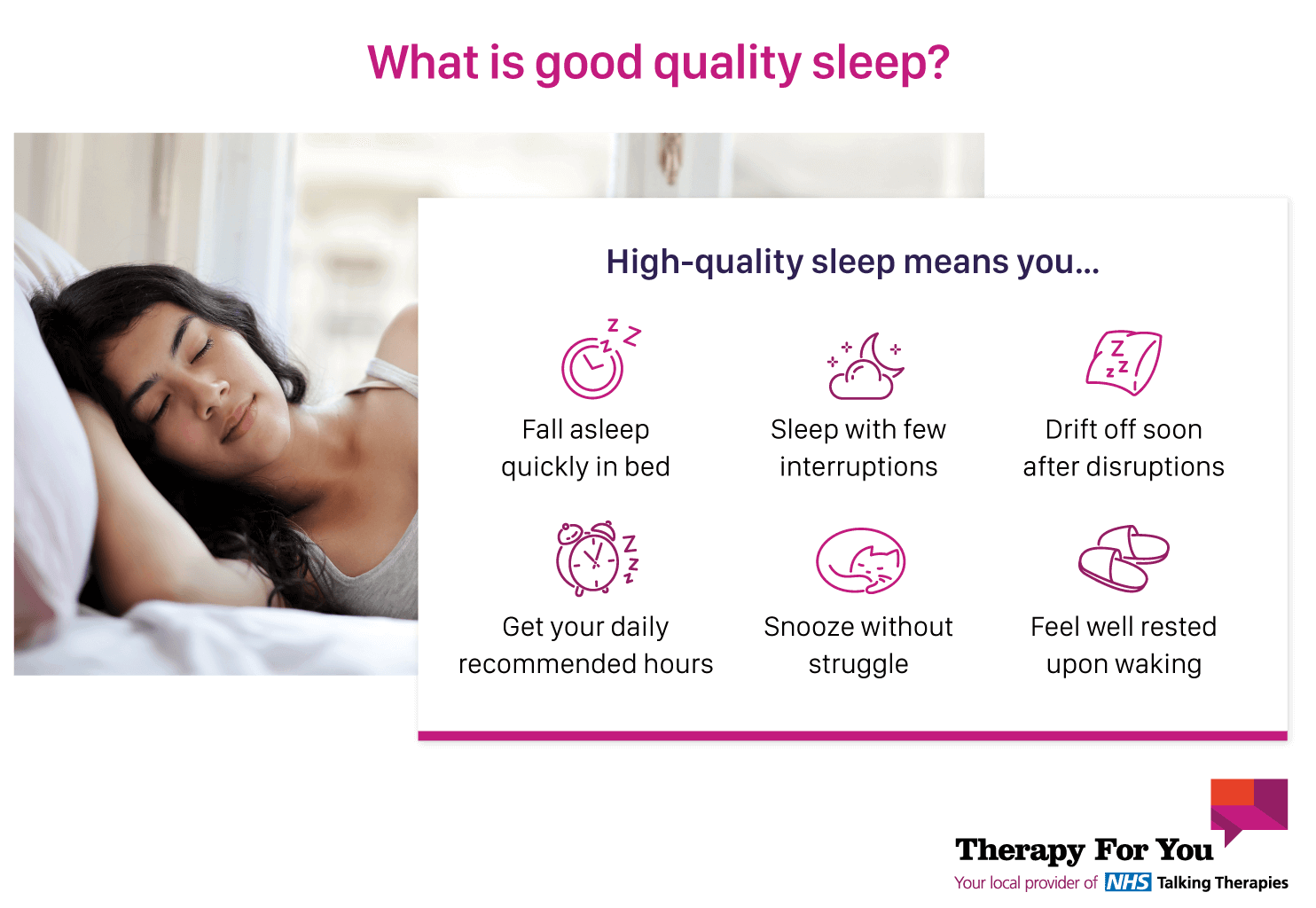
What is good quality sleep?
As well as getting the right amount of sleep, it is just as important to get high-quality rest.
What problems can I face with my sleep?
Although sleep is an essential part of a healthy lifestyle, as few as 20% of people in the UK get the amount they need.
If this is a reality for you, and you regularly find yourself waking in the middle of the night, lying awake in bed, or feeling tired upon waking, this could be a sign that you have insomnia.
What are the different types of insomnia?
Short-term insomnia
If your sleep issues have lasted less than 3 months, this is referred to as short-term insomnia. Typically brought about due to a significant life change, such as the loss of a loved one or the end of a relationship, short-term insomnia tends to fade over time.
Chronic insomnia
If you have struggled getting regular sleep for more than 3 months, you may have chronic insomnia. This type of sleep disorder is harder to overcome, and characterised by frequent, relentless episodes of poor sleep that can endure for days, weeks or months at a time.
While these are the two most common ways to describe insomnia, healthcare professionals may refer to your condition as:
- Sleep onset insomnia – when you have trouble initially dozing off
- Sleep maintenance insomnia – when you find it hard to stay asleep
- Early morning awakening insomnia – when you wake up long before you need to be
- Comorbid insomnia – when your condition is thought to be triggered by something like stress or a long-term health problem
What causes insomnia?
Insomnia affects as many as 1 in 3 people in the UK, and can impact people at any age. Multiple factors can contribute to the development of this and other sleep disorders, including:
- Feelings of stress and anxiety
- Long-term conditions, like sleep apnoea
- An uncomfortable sleep environment
- Medication that has rest-altering side effects
- Unsociable working hours
- Alcohol or caffeine consumption
- Bed sharing with a partner
- An inconsistent sleep schedule
- Frequent and persistent nightmares
How can sleep problems affect me?
Sleep is core to healthy living. If you aren’t getting the right amount of quality rest, you could be at risk of developing long-term medical conditions, such as:
- Strokes
- Seizures
- Obesity
- Diabetes
- High blood pressure
- Heart disease
Sleep deprivation can also cause unhelpful thoughts and feelings to bubble up, leading to anxiety disorders and depression. This can have a very real impact on your life:
- Concentrating at work when you’re tired can become a challenge
- Taking on feedback from colleagues might cause friction if you are irritable
- A lack of energy could cause you to avoid socialising with friends and family
- Tiredness might affect your judgement and lead you to make poor decisions
Do I have a problem with my sleep?
Everybody has difficulties getting to sleep from time to time. Maybe a late night out with friends has left you excited and unable to drift off. Or perhaps a stressful day at work has given you racing thoughts you’re struggling to silence.
It is only when poor sleep becomes a regular occurrence in your life and affects your overall health and wellbeing that it could be viewed as an ongoing problem. To determine if sleep treatment could benefit you, consider:
- Do you have issues falling asleep regularly?
- Do you experience prolonged episodes of poor rest?
- Do you find yourself waking up more than once every night?
- Do you rise earlier than you need to and struggle to fall back asleep?
- Do you rarely feel refreshed upon waking?
- Do you find it hard to nap during the day, even if you’re tired?
- Do you often feel agitated and unable to focus?
Everybody experiences sleep differently. But if one or more of these signs are true for you and causing your quality of life to suffer, it might be time to reach out and get the help you need.
Ready to start your journey to feeling better with Therapy For You?
Discover our treatment pathways, gain lifelong techniques to improve your wellbeing and embrace a happier, healthier future.
Omni Online CBT
Instantly begin an online video course delivered by trained NHS clinicians.
Talking Therapies
Make a self-referral for our 1-1, group, phone or video therapy sessions.
Mindler Typed Therapy
Check your eligibility for Mindler and text a qualified therapist around your schedule.
link